
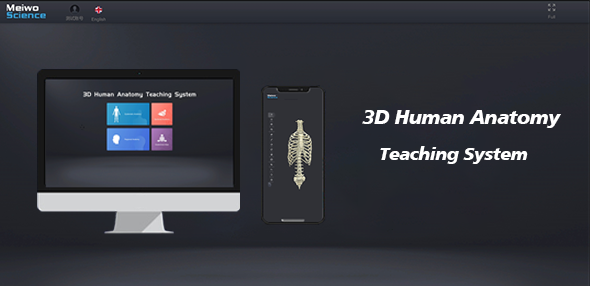
Students' learning interest can effectively enhance their initiative and cultivate sustained cognitive interest, which is crucial for initiating, maintaining, and completing learning activities. Medical teaching software integrates various information transmission methods such as text, images, video, VR, AR, and MR, possessing strong realism and expressiveness. It can fully mobilize students' learning enthusiasm, generating strong learning passion and interest, thus improving the quality of medical teaching.
Medical teaching software utilizes the rich expressiveness of multimedia technology to present abstract medical content through animation and simulation, transforming the abstract into the concrete and the static into the dynamic, greatly enhancing the expressiveness of medical classroom teaching. For example, when explaining human anatomy, a human body assembly module can be used. This module covers the cardiovascular, digestive, respiratory, nervous, immune, urinary, reproductive (male and female), muscular, skeletal, endocrine, visual, and skull (whole or partial) human body puzzles, helping students better understand the composition and structure of various human systems and organs, while greatly increasing the enjoyment of learning.
Medical teaching software plays an irreplaceable role in stimulating students' learning interest, assisting them in forming concepts, consolidating knowledge, acquiring experimental skills, and cultivating observation and experimental abilities. Many medical changes are fleeting, and when teachers conduct demonstration experiments, they must both perform the experiments themselves and manage students' attention, sometimes making it difficult to effectively organize simultaneous thinking and discussion, resulting in a less than ideal atmosphere of exploration and experimentation. However, using medical teaching software and its 3D animation simulations can effectively solve these problems.
.png)
Using medical teaching software to assist medical students' learning can extend medical education beyond the classroom and laboratory, allowing teaching and learning to be extended and expanded in time and space. For example, teachers can publish their lesson plans and courseware on the medical teaching software for students to view and study on their computers or mobile phones during their spare time, providing students with a good extracurricular learning environment.

